
Background
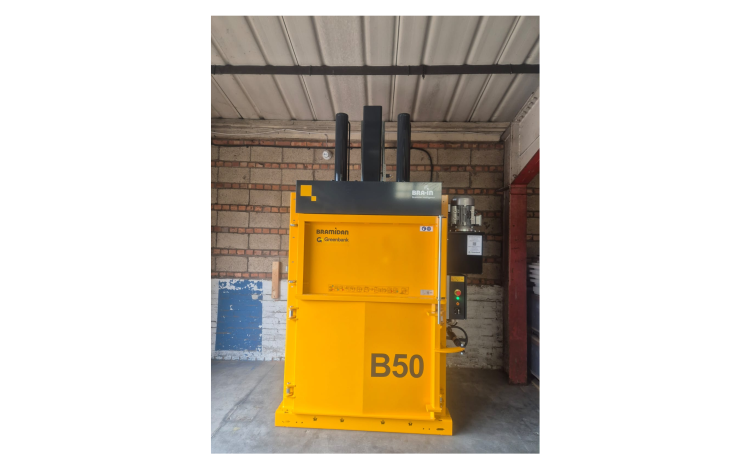
During an engineer visit, Greenbank identified that Fischer Future Heat’s ageing B50 Vertical Baler was beginning to require increasingly frequent repairs. Rather than viewing this solely as an equipment replacement, the team reviewed the complete cardboard recycling process to identify opportunities for greater efficiency. The recommended solution reduced the labour required and cut cycle time by 53%.
The Challenge
Fischer Future Heat’s existing B50 had provided many years of service. As the machine aged, however, it began to require increasing amounts
of maintenance and repair work.
“We replaced the old B50 due to the cost of repairs. Because of its age, it was starting to need a lot of work.”
During an engineer visit, Greenbank recognised that the growing repair requirements could begin to affect the reliability and cost
effectiveness of Fischer Future Heat’s recycling operation.
The engineer’s feedback prompted Greenbank to contact the customer proactively and review its requirements before the situation
resulted in further expense or downtime.
The assessment also highlighted a wider operational issue: recyclable material was taking employees longer than necessary to process, this
time could be used for other business critical activities
Reviewing the process
Greenbank reviewed how recyclable material moved through the process, how employees interacted with the existing equipment and
where time was being lost. Based on its findings, Greenbank recommended a familiar solution that would be straightforward for the team to adopt while significantly reducing processing time.
The recommended configuration reduced each processing cycle from 55 seconds to 26 seconds, a reduction of approximately 53%.
This meant recyclable material could be processed in less than half the time per cycle, allowing employees to return to their core
responsibilities sooner.
Greenbank managed the process from the proactive initial contact and assessment through to its recommendations, quotation and
installation.
“Communication was very good throughout the whole process, from start to finish.
Giving time back to the team
The most significant improvement for Fischer Future Heat has been the reduction in time employees spend processing recyclable material.
Rather than waiting through a longer cycle each time material is loaded, the team can now complete the task more quickly and
continue with the rest of its working day.
“The faster cycle time has made a big difference because we now spend less time at the baler.”
The updated process has remained simple and familiar for employees, helping Fischer Future Heat introduce the improvement without
unnecessary complexity or disruption.
Smaller practical improvements, including more convenient wire storage and an improved wire-feeding system, have also made the
overall process easier for the team.
“The wire hooks on the side are much better and make the wires easier to store. The feeder for the wires is also a big improvement.”
The Outcome
Greenbank’s proactive, process-led approach has helped Fischer Future Heat achieve:
• A reduction in processing time from 55 seconds to 26 seconds per cycle
• Approximately 53% less time required for each cycle
• Less employee time spent processing recyclable material
• More time available for employees’ core responsibilities
• A straightforward transition with minimal disruption
• Reduced reliance on costly repairs
• A simpler day-to-day recycling process


